
The Majestic Khan As'ad Pasha al-Azm ia The Crown Jewel of Damascus
The scent of roasted spices and dried herbs from the Al-Buzuriyah Souq leads you toward a massive stone portal that feels more like the entrance to a palace than a commercial inn. This is Khan As'ad Pasha al-Azm
What to expect?
When you step into the ancient, narrow alleys of the Old City of Damascus, time seems to slow down. The scent of roasted spices and dried herbs from the Al-Buzuriyah Souq leads you toward a massive stone portal that feels more like the entrance to a palace than a commercial inn. This is Khan As'ad Pasha al-Azm, arguably the most beautiful and sophisticated example of Ottoman architecture in the Levant.
At yalla-syria, we believe that every stone in Damascus tells a story. Today, we invite you to step inside this "Cathedral of Commerce" and discover why it remains a must-visit destination for anyone exploring the heart of Syria.
A Legacy Set in Stone: The History of the Khan
The story of the Khan begins in the mid-18th century. It was commissioned by the Governor of Damascus, As'ad Pasha al-Azm, a man known for his refined taste and architectural ambition (he also built the famous Azm Palace nearby). Construction began in 1166 AH (1752-1753 AD) and took only a year and two months to complete—a remarkable feat given the intricacy of its design.
The building served as a "Khan" (a caravanserai), a vital hub for merchants and travelers arriving from the Silk Road. It provided a safe haven for goods, a place for trade, and a luxurious lodging for weary travelers. However, its resilience was tested early on. Just six years after its completion, a massive earthquake struck Damascus, causing three of its iconic domes to collapse. Despite this, the Khan stood tall, witnessing the rise and fall of empires until the early 20th century, when it transitioned into private ownership by local merchants.
In 1976, the Syrian Ministry of Culture recognized its immense historical value and began a meticulous restoration process. Today, managed by the General Directorate of Antiquities and Museums, it has been transformed from a warehouse into a vibrant cultural center, hosting art exhibitions, intellectual forums, and thousands of awe-struck tourists.
Where Architecture Meets Art
Located south of the Umayyad Mosque and overlooking both the Al-Buzuriyah Souq and Souq al-Waraq, the Khan’s exterior is impressive, but its interior is where the magic happens.
The Grand Entrance
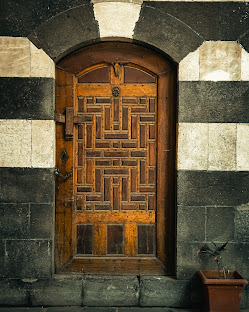
The western facade is a masterpiece of stonework. It features a towering recessed arch decorated with muqarnas (stalactite carvings) and stone pendants. The massive wooden doors, reinforced with iron plates, contain a smaller door known as the "Khoukha." This allowed residents to enter or exit at night without opening the main heavy gates. Above the door, a finely carved inscription commemorates the founding of the Khan, flanked by two stone water fountains (sabils) that once quenched the thirst of passersby.
The Play of Light and Shadow: The Central Courtyard
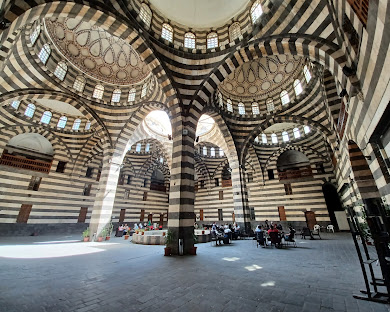
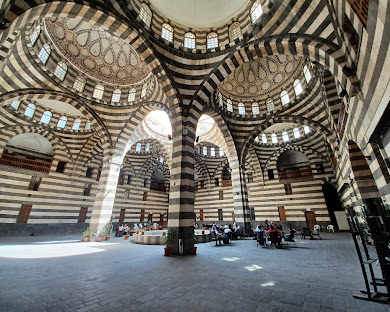
As you pass through the cross-vaulted vestibule, you emerge into a breathtaking courtyard spanning approximately 2,500 square meters. The floor is paved with striking black basalt, centering around a large, polygonal fountain (fasqiya).
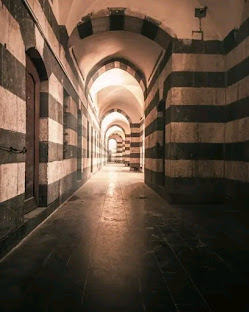
The most striking feature is the ceiling. Traditionally, Khans had open courtyards, but As'ad Pasha’s design is unique. It features nine domes in total. In 2005, a sophisticated restoration added a retractable glazed metal roof over the central opening, allowing the space to be used year-round while maintaining the natural light that dances across the "Ablaq" (alternating black and white) stone walls.
A Two-Story Masterpiece of Functionality
The Khan’s layout is a perfect blend of business and hospitality:
• The Ground Floor: This level was designed for commerce. It contains 23 independent wings, each consisting of a front office and back storage rooms. Unlike older Khans, this layout mirrors the symmetry of Umayyad palaces, such as Qasr al-Hayr al-Gharbi.
• The First Floor: Reached by two stone staircases, the upper level features a beautiful gallery overlooking the courtyard through twelve harmonious arches. Here, 44 identical rooms served as hotel suites for traveling merchants. Each room features cross-vaulted ceilings, traditional plasterwork, and windows protected by original iron grilles that have survived for centuries.
The Hidden Mosque
Adjacent to the Khan is a small, separate mosque. Interestingly, historical records from scholars like Wulzinger and Watzinger suggest this mosque predated the Khan. As’ad Pasha’s architects chose to preserve it, giving it a private entrance from Al-Buzuriyah Souq.
Inside, the mosque holds a spiritual stillness. It contains a prayer hall with a pointed barrel vault and a raised platform housing two significant shrines: one for Ubaidullah bin Umar bin al-Khattab and another for the Sufi scholar Sheikh Muhammad al-Buzuri. It is a unique architectural anomaly that adds a layer of spiritual depth to the commercial grandeur of the site.
A Global Icon of Beauty
The beauty of Khan As'ad Pasha has long captivated international visitors. In 1823, the famous French poet and traveler Lamartine visited the Khan and was left speechless. He described it as:
"A piece of architecture with a richness of luxurious details unparalleled in the world... it represents Arab-Islamic architecture in its most complete form."
Why You Should Visit with yalla-syria
Walking through Khan As'ad Pasha isn't just a sightseeing trip; it’s an immersive experience in Syrian heritage. Whether you are a photography enthusiast looking for the perfect shot of the domes or a history buff eager to touch the "Ablaq" stones, this site offers something for everyone.
Quick Facts for Your Visit:
• Location: Al-Buzuriyah Souq, Old Damascus.
• Best Time to Visit: Mid-morning, when the sunlight streams through the dome windows.
• Nearby Attractions: The Umayyad Mosque, Azm Palace, and the Spice Market.
At yalla-syria, we are dedicated to bringing you the best of Syria’s hidden gems. Damascus is a city that never stops giving, and Khan As'ad Pasha is its most brilliant artistic signature.
At yalla-syria, we believe that every stone in Damascus tells a story. Today, we invite you to step inside this "Cathedral of Commerce" and discover why it remains a must-visit destination for anyone exploring the heart of Syria.
A Legacy Set in Stone: The History of the Khan
The story of the Khan begins in the mid-18th century. It was commissioned by the Governor of Damascus, As'ad Pasha al-Azm, a man known for his refined taste and architectural ambition (he also built the famous Azm Palace nearby). Construction began in 1166 AH (1752-1753 AD) and took only a year and two months to complete—a remarkable feat given the intricacy of its design.
The building served as a "Khan" (a caravanserai), a vital hub for merchants and travelers arriving from the Silk Road. It provided a safe haven for goods, a place for trade, and a luxurious lodging for weary travelers. However, its resilience was tested early on. Just six years after its completion, a massive earthquake struck Damascus, causing three of its iconic domes to collapse. Despite this, the Khan stood tall, witnessing the rise and fall of empires until the early 20th century, when it transitioned into private ownership by local merchants.
In 1976, the Syrian Ministry of Culture recognized its immense historical value and began a meticulous restoration process. Today, managed by the General Directorate of Antiquities and Museums, it has been transformed from a warehouse into a vibrant cultural center, hosting art exhibitions, intellectual forums, and thousands of awe-struck tourists.
Where Architecture Meets Art
Located south of the Umayyad Mosque and overlooking both the Al-Buzuriyah Souq and Souq al-Waraq, the Khan’s exterior is impressive, but its interior is where the magic happens.
The Grand Entrance
The western facade is a masterpiece of stonework. It features a towering recessed arch decorated with muqarnas (stalactite carvings) and stone pendants. The massive wooden doors, reinforced with iron plates, contain a smaller door known as the "Khoukha." This allowed residents to enter or exit at night without opening the main heavy gates. Above the door, a finely carved inscription commemorates the founding of the Khan, flanked by two stone water fountains (sabils) that once quenched the thirst of passersby.
The Play of Light and Shadow: The Central Courtyard
As you pass through the cross-vaulted vestibule, you emerge into a breathtaking courtyard spanning approximately 2,500 square meters. The floor is paved with striking black basalt, centering around a large, polygonal fountain (fasqiya).
The most striking feature is the ceiling. Traditionally, Khans had open courtyards, but As'ad Pasha’s design is unique. It features nine domes in total. In 2005, a sophisticated restoration added a retractable glazed metal roof over the central opening, allowing the space to be used year-round while maintaining the natural light that dances across the "Ablaq" (alternating black and white) stone walls.
A Two-Story Masterpiece of Functionality
The Khan’s layout is a perfect blend of business and hospitality:
• The Ground Floor: This level was designed for commerce. It contains 23 independent wings, each consisting of a front office and back storage rooms. Unlike older Khans, this layout mirrors the symmetry of Umayyad palaces, such as Qasr al-Hayr al-Gharbi.
• The First Floor: Reached by two stone staircases, the upper level features a beautiful gallery overlooking the courtyard through twelve harmonious arches. Here, 44 identical rooms served as hotel suites for traveling merchants. Each room features cross-vaulted ceilings, traditional plasterwork, and windows protected by original iron grilles that have survived for centuries.
The Hidden Mosque
Adjacent to the Khan is a small, separate mosque. Interestingly, historical records from scholars like Wulzinger and Watzinger suggest this mosque predated the Khan. As’ad Pasha’s architects chose to preserve it, giving it a private entrance from Al-Buzuriyah Souq.
Inside, the mosque holds a spiritual stillness. It contains a prayer hall with a pointed barrel vault and a raised platform housing two significant shrines: one for Ubaidullah bin Umar bin al-Khattab and another for the Sufi scholar Sheikh Muhammad al-Buzuri. It is a unique architectural anomaly that adds a layer of spiritual depth to the commercial grandeur of the site.
A Global Icon of Beauty
The beauty of Khan As'ad Pasha has long captivated international visitors. In 1823, the famous French poet and traveler Lamartine visited the Khan and was left speechless. He described it as:
"A piece of architecture with a richness of luxurious details unparalleled in the world... it represents Arab-Islamic architecture in its most complete form."
Why You Should Visit with yalla-syria
Walking through Khan As'ad Pasha isn't just a sightseeing trip; it’s an immersive experience in Syrian heritage. Whether you are a photography enthusiast looking for the perfect shot of the domes or a history buff eager to touch the "Ablaq" stones, this site offers something for everyone.
Quick Facts for Your Visit:
• Location: Al-Buzuriyah Souq, Old Damascus.
• Best Time to Visit: Mid-morning, when the sunlight streams through the dome windows.
• Nearby Attractions: The Umayyad Mosque, Azm Palace, and the Spice Market.
At yalla-syria, we are dedicated to bringing you the best of Syria’s hidden gems. Damascus is a city that never stops giving, and Khan As'ad Pasha is its most brilliant artistic signature.
Reviews & Ratings
0.0
★★★★★
0 reviews
💬
No reviews yet. Be the first to review!
Contact & Location
Old City
Damascus
Activity
49
Views
4
Likes
The Majestic Khan As'ad Pasha al-Azm ia The Crown Jewel of Damascus
Similar Places
10 Places Every Syrian Remembers From Childhood
Damascus
New
Culture & Lifestyle
Unveiling the Cradle of History: Your Ultimate Guide to Syria Museums
Tartus
New
Culture & LifestyleDiscover Our Lady of Saidnaya Monastery: History, Faith, and Visitor Guide
Damascus
New
Culture & Lifestyle.jpeg&w=1200&q=75)
Cherubim Monastery Syria: A Journey Above the Clouds
Damascus
New
Culture & Lifestyle
The Ultimate Guide to the Great Umayyad Mosque in Damascus
Damascus
New
Culture & LifestyleSyria Shines Again: Experiencing the 63rd Damascus International Fair
Damascus
New
Culture & LifestyleMore in Damascus

A Taste of Damascus: 5 Authentic Local Restaurants You Must Visit
Damascus
New
Caffe & Restaurants
Eagle Hills Syria: A New Vision for Damascus and Latakia
Damascus
New
Investment
Fashion Gate Mall Syria: A New Luxury Shopping Destination in Damascus
Damascus
New
Markets & Shopping
Investing in Damascus: Tourism, Hospitality & Real Estate
Damascus
New
InvestmentSki Land Damascus: When Ice Skating Brings Back the Joy
Damascus
5.0(1)
Adventure 
Boozet Bakdash in Damascus: Discover Syria’s Legendary Ice Cream Tradition
Damascus
New
Food & DrinkMore Culture & Lifestyle Places

Syrian Makdous: The Taste of Autumn, Childhood and Home
Syria
New
Culture & Lifestyle10 Places Every Syrian Remembers From Childhood
Damascus
New
Culture & Lifestyle.jpeg&w=1200&q=75)
Discovering the Euphrates River: History, Travel, and Beauty in Syria
Raqqa
New
Adventure Unveiling the Cradle of History: Your Ultimate Guide to Syria Museums
Tartus
New
Culture & LifestyleDiscover Our Lady of Saidnaya Monastery: History, Faith, and Visitor Guide
Damascus
New
Culture & Lifestyle
Echoes of History: Discovering 10 Magnificent Castles in Syria
Syria
New
Culture & Lifestyle